

 834
834
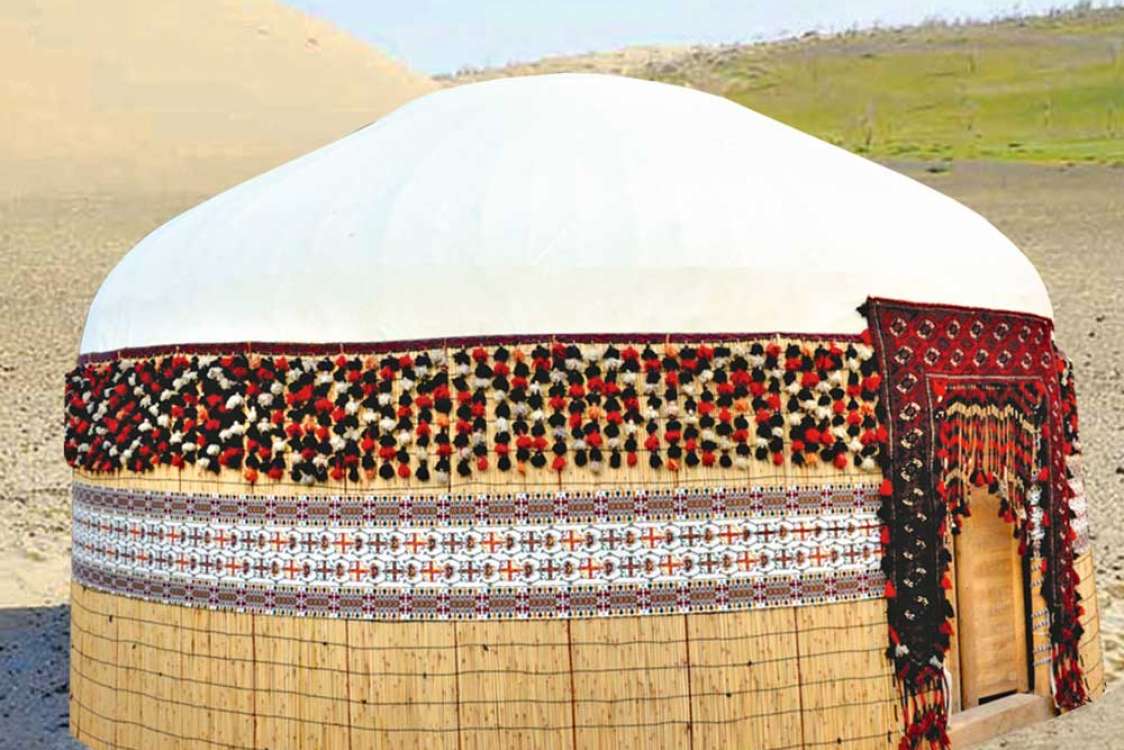
The yurt, as a wonderful achievement of ancient nomadic architecture, is a vivid demonstration of the amazing harmony of nature and man, says Atadurdy Eyeberdiyev, a member of the International Association for Falconry in his article published on Neutral Turkmenistan.
A famous architect of the 20th century Le Corbusier wrote, “The yurt is one of the highest achievements of architecture. Due to its proportions commensurate with humans, it harmoniously fits into the landscape, serving as an example of the unity of nature and human habitation.” By creating this dwelling that was perfect in its functional qualities, our ancestors could see an image, embodying true similarity with the spiritual and moral values of human existence, in the yurt.
A small village in the desert woke up early to celebrate the spring holiday, Nowruz Bayram. Children and young people gathered near a large dune where swings were installed. Women dressed in their best clothes were reflected in the fire under large cauldrons as they cooked a festive meal. A large yurt was assembled near the wide takyr, south of the village, where races were to take place. Many villagers and guests gathered inside the yurt at the festive dastarhan in the evening. After a common meal, the esteemed aksakals read a prayer of gratitude, and young people arranged everything needed for tea on the dastarhan. As usual, everyone looked forward to the instructive stories of the good-natured Ahmet aga over a cup of tea.
Ahmet aga began his story by talking about how the installation of a portable house was ingeniously simple and amazingly orderly. He talked about how our fathers considered true simplicity a measure of reliability and strict order a guarantee of cleanness. The master of poetic words, Magtymguly, believed that to live in modesty and simplicity means to live according to conscience and honor. People were amazed at how the external and internal decoration of the yurt was perfectly combined with practicality and artistic taste. Ahmet aga said that decorating the outer world with spiritual asceticism decorates the inner world with piety, dignity, and nobility. Listening to the elder’s stories, people discovered the aesthetic environment of the yurt. For them, this dwelling was not only a cozy home but also a way of being, which reflects both the material and spiritual world, embodied in handmade felt, wood, and artisans’ skills.
Ahmet aga also talked about the design of the yurt and how the streamlined shape of the wall makes the yurt more resistant to strong winds and blizzards. The spherical shape of the portable dwelling allows it to perfectly respond to the vital rhythm of nature, easily changing the air exchange and lighting systems depending on the change in time of day and night. The sun and moon, being natural sources of light for the yurt, create a healing microclimate in the home. Caliph Omar once said, ‘The sun is reflected in a drop of clean water, but the sky is reflected in the pure heart of a person, and the heart becomes pure only by wishing peace to others.
Ahmet aga noted that our ancestors perceived a portable dwelling as a symbolic garment that was transported together with a person. The two concentric circles of the yurt – the base and the smoke hole – are a conditional connection between man and the earth and sky, illustrating how the simplicity and purity of the human heart rise to the skies. The yurt, as a wonderful achievement of ancient nomadic architecture, is a vivid demonstration of the amazing harmony of nature and man. The skill of men in making the wooden bases of the yurt and the art of women making felt coverings for insulating portable homes are combined in this coherence of human existence. Thus, the image of the yurt is filled with the institution of family – the dwelling is based on strong poles made by men and is warmed by dense felt made by women’s hands.
Ahmet aga finished his short story without waiting for any questions. He concluded with the statement that the yurt, a traditional dwelling, was created with the principles of convenience, reliability, and beauty in mind. He then spoke about the importance of human integrity, which is necessary for a chaste life. To achieve this, one must possess spiritual sincerity and purity of heart. This will allow a person to build a temple of friendship and cultivate a tree of mercy.
It is both interesting and beneficial for us to understand the creative process of ancient masters and their aesthetic ideas that served as the foundation for the construction of the yurt. By researching this aspect of our national tangible culture and craft, we can revive the spiritual and moral principles of our ancestors. These traditional and fundamental values must continue to inspire constructive and creative forces that preserve the cultural heritage and strengthen our connections to the past. Above all, this is a valuable contribution to the development of the human soul.
5585
5405
5325
4726
157
245

 338
338
 245
245
 310
310
 314
314

 371
371
 318
318
 485
485
 399
399