

 896
896
Neutral Turkmenistan published an interview with Muhammet Mamedov, the Head of the National Directorate for the Protection, Study, and Restoration of Historical and Cultural Monuments at the Ministry of Culture of Turkmenistan. An interview about the historical sites of Anau was conducted by Irina Imamkuliyeva.
The city of Anau was declared the Cultural Capital of the Turkic World 2024. The decision was made unanimously following the 39th Term Meeting of the Permanent Council of TURKSOY, which was held in Bursa (Türkiye). This status is awarded to ancient cities, the history of which is inextricably linked with the history of the formation of Turkic-speaking nations in the Age of Antiquity and the Middle Ages, to bind together the Turkic world with common cultural and artistic wealth, to strengthen unity, solidarity and brotherhood among the Turkic peoples and to promote culture and art of the Turkic world worldwide.
Interviewer: “There are not many places on the planet which have evidence shedding light on the crucial stages in the development of human civilisation. One of these places is the foothills of the Kopetdag Mountains in Turkmenistan. There, the ancient settled agricultural area, known as the Anau civilisation, emerged in the northern foothill plain in the V-IV millennia BC. With unflagging interest, one archaeological expedition after another sieved through hundreds of cubic metres of soil to find unique and invaluable historical artefacts in the depth of cultural layers hidden from view for thousands of years. Traces of which civilisations are preserved in the monuments of Anau?”
M. Mamedov: “Archaeological studies have found that an ancient agricultural civilisation existed in this region in the VII-VI millennia BC. The monuments of the so-called Jeytun civilisation were first identified and studied by academician V.M. Masson in the mid-twentieth century. In 1904, Professor Raphael Pumpelly organised a complex expedition to study the Anau mounds. They discovered a wide range of archaeological finds belonging to the ancient agricultural civilisation of the Eneolithic Period (V millennium BC). Along with the remains of ancient buildings, tools, ceramic dishes and other objects, they found charred remains of barley and wheat grains. It was also established that farmers of ancient Anau had melted copper and had made jewellery and kitchen utensils of it.
“The discovery allows concluding that Central Asia and, in particular, the territory of Turkmenistan, was one of the earliest regions in the world where people began to grow a variety of grains. For example, the people of the Anau civilisation, the ancestors of the Turkmen people, were among the first in human history to cultivate wheat and to bake bread from white flour. Raphael Pumpelly gave his discovery the name of the Anau civilisation, and it forever entered scientific terminology. According to V.M. Masson, this civilisation was a logical continuation of the Jeytun civilisation, but at a higher level.”
Interviewer: “To what you said, I would add that it was the Carnegie Foundation in Washington that made it possible for Pumpelly to conduct excavations in Anau. Pumpelly, who was 73 years old at that time, and even though he was a geologist and not an archaeologist, enthusiastically decided to use this chance, because he had got interested in Turkmenistan even earlier as in a place where a civilisation unknown to science could well be discovered. Pumpelly invited an experienced archaeologist Hubert Schmidt, who worked with the legendary Heinrich Schliemann, to join his expedition.”
M. Mamedov: “The materials collected by Pumpelly became the main source for the study of ancient agricultural civilisations of Southern Turkmenistan for many years. In the 1920-30s, D.D. Bukinich and A.A. Marushchenko examined the archaeological mounds of Anau. Starting from the 1950s, the Southern Turkmenistan archaeological complex expedition excavated a large number of other monuments containing archaeological layers associated with the Anau civilisation, the distribution area of which covered the entire foothill strip in the Ahal Velayat. In general, all studies of the Anau civilisation give reason to state that it was a high culture and as ancient as Babylon, and even more ancient than Egypt of the pharaohs.”
Throughout 2024, the Turkic world will be witnessing a bright and diverse palette of cultural and humanitarian events spotlighting the rich and unique culture of Anau. These events will serve to widely promote the invaluable historical and archaeological sites of Turkmenistan that, like gems, adorn the necklace of the boundless heritage of the Turkic world.
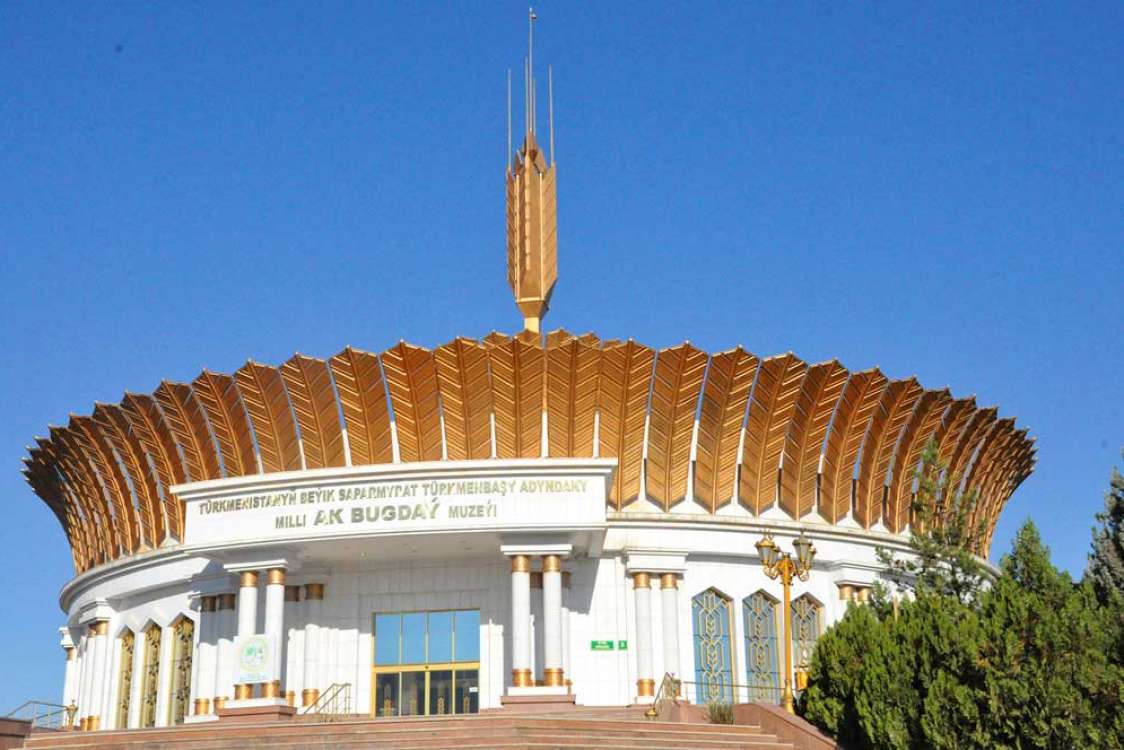
Interviewer: “It is not accidental that it was in that place, where, according to indisputable evidence of scientists, the earliest centre of irrigated agriculture in the history of humankind was located, that the Ak Bugdaý National Museum opened in July 2005. The most unique exhibit is 5,000-year-old wheat grains, discovered by the expedition of Raphael Pumpelly in 1904. The museum collection also contains the finds discovered in other agricultural settlements of the Kopetdag Valley. These are stone grain grinders (II millennium BC), hand millstones (III–II millennia BC), a bronze hoe (II millennium BC) and an oil churn for squeezing oil from sesame seeds.”
M. Mamedov: “Terracotta figurines of fertility goddesses from Namazga Depe, dating back to the IV millennium BC, testify to the development of irrigated agriculture. These are miniature depictions of sitting women, their eyes are featured as oval marks, similar to wheat grains, and their hair is put in two braids. There are schematic images of wheat ears on the shoulders of some of them and drops of rain or lightning associated with fertility on others. There is a reason to believe that these figurines had a place of honour in the homes of ancient farmers; they were kept in special niches near the hearths and worshipped in the hope of the bounty of the earth.”
Interviewer: “The discovery made by an archaeologist Fredrik Hiebert from the University of Pennsylvania was no less sensational. In 2000, his expedition discovered a miniature stone stamp with the sides barely exceeding one centimetre, during excavations near Anau. There are letters, which are unlike any writing system known to science, carved on it.
“When the scientist showed photographs of this stamp to orientalists in America, they were puzzled. It is clear that this is neither the Mesopotamian cuneiform script, hitherto considered the earliest writing system, nor the Proto-Elamite script that once existed on the Iranian Plateau. Experts in Indian archaeology noted that the form of the stamp from Anau did not coincide with the forms of known stamps from India, and only one sign is somewhat reminiscent of the letter of the ancient Indian script. Experts in ancient Chinese civilisation assured that its symbols were obviously not Chinese because writing emerged in China several centuries after the stamp from Anau had been made. Dr W. Meyer at the University of Pennsylvania assumed that, whatever the origin of this stamp is of, the type of symbols and the small number of incisions used to create each sign make it seem that this writing system is quite abstract and not pictographic. Does this mean that the ancestors of the Turkmen people could write 4,000 years ago?!
“Moreover, archaeologists discovered the remains of a multi-room brick palace. This indicates that there was a civilisation that developed its own writing in the Bronze Age, around 2000 BC, in the place where the Great Silk Road has lain 2,000 years later.”
M. Mamedov: “The most famous monument of the medieval history of Anau is the mosque of Sheikh Seyit-Jamal ad-Din, popularly called Seyit Jemaletdin. This monument absorbed the best traditions of architectural and artistic styles of the Timurid period. Unfortunately, the mosque was destroyed by the earthquake in 1948, but thanks to the architectural and artistic description made a year before the earthquake by architect G.A. Pugachenkova, we can imagine this “House of Beauty”, as researchers poetically called the mosque.
“According to the inscriptions on the façade, the mosque was built in 1455–1456 in honour of Sheikh Jalal-ad-dunya-wa-d-Din. The inscription also stated that this building was constructed during the reign of the great Sultan Abu-l-Qasim Baber Bahadur Khan. Other inscriptions provided information that the “House of Beauty” was built at his own expense by Muhammad in 1455–1456 in memory of his father Jamal ad-Din. Galina Pugachenkova convincingly identifies the name of Muhammad, mentioned in the text on the mosque, with the vizier of the Sultan, Muhammad Hudaydot, whose buried father Jamal ad-Din was a native of Anau. Indeed, there is the grave of a Jamal ad-Din in the courtyard of the mosque. Pilgrims, mostly women, come there asking the saint for help and healing from illnesses.”
Interviewer: “What is known about the personality of Jamal ad-Din?”
M. Mamedov: “Almost nothing is known about the personality of Jamal ad-Din. The hagiographic literature of the Timurid period has no mentions of this name. Perhaps he was a respected citizen of religious rank who suffered martyrdom while defending the city from enemies. I hope that young researchers will find the answer to this question. However, there is no doubt that the mosque was built near the grave revered by local people. This is illustrated by the choice of location – the mosque was built on the very cliff of the fortress wall of the ancient settlement of Anau. Moreover, the tradition of building cult complexes near revered graves became widespread in the Timurid period.
The ensemble comprises four buildings: a mosque, which is a large domed hall, a tombstone in front of it and two large buildings with high domed halls. The ensemble represents a complex volumetric-spatial composition. The building was distinguished by a great variety of vaulted constructions and colourful cladding.”
Interviewer: “The unique decoration of the portal: ornamental brick lining with majolica inserts, geometric patterns and extensive mosaic Arabic text had the greatest value and artistic peculiarity. Two azhdarkha dragons with their heads turned to each other are depicted above the arch. Their yellow bodies wriggled against a dark blue mosaic background with small floral patterns (apple blossoms), which stretched from the grinning mouths of fantastic creatures. The depiction of dragons among the ornament of flowering branches on the entrance portal is a mystery to researchers because zoomorphic images and mythical creatures are not typical for Muslim sanctuaries. Fragments of the decor are now on display at the Museum of Fine Arts of Turkmenistan.”
M. Mamedov: “Yes, indeed, the depictions of dragons on the portal of the mosque have no analogues in the decoration of architectural monuments in Central Asia. A comprehensive description of the origin of this plot in the decor of the Anau Mosque has not been found so far. According to G. Pugachenkova, this is apparently a totem of the main Turkmen tribe who resided in the surroundings of Anau in the 15th century, to which Sheikh Jamal ad-Din may have belonged. It is also possible that this is associated with the family coat of arms of the ruling dynasty of the city.
“At the same time, the image of reptiles can be interpreted as an embodiment of the idea of fertility. It is not difficult to recognise character images on the stamps of snakes, crawling out of the underworld and symbolising water, popular in ancient Bactria and Margiana, in the dragons of the Anau Mosque. Their paws and spine resemble rain dragons. The ancestors of the Central Asian peoples believed that fairy-tale dragons were guardians of innumerable treasures.”
Interviewer: “By the way, the first researchers of Seyit-Jamal ad-Din Mosque recorded a legend based on the stories of old people, explaining the emergence of such an extraordinary building. It says that during the reign of the wise she-ruler Jamal, the city residents were alarmed by the continuing ringing of the alarm bell. A huge azhdarkha dragon was ringing the bell. It was begging people for something, pointing towards the mountains and two men with an axe and a saw. By order of the queen, they followed the dragon, which led them to its friend. It turned out that the she-dragon had swallowed a whole mountain goat and was suffocating. The brave men sawed off the horns and carcass of the goat and saved the dragon. In gratitude, the dragons gave innumerable treasures to the craftsmen and the city. The queen ordered the construction of a mosque using these gifts and the depiction of azhdarkha dragons on the portal.”
5585
5405
5325
4726
157
245

 338
338
 245
245
 310
310
 314
314
 371
371
 318
318
 485
485
 399
399