

 989
989
The monuments of the Anau civilization are of exceptional interest to scientists. Their thorough research is particularly relevant in the year of the declaration of Anau as the Cultural Capital of the Turkic World. Olga Adykova, a senior research worker at the Institute of History and Archaeology, Academy of Sciences of Turkmenistan, shares a piece of unique information about sanctuaries found on Anau historical sites in her article published on Neutral Turkmenistan.
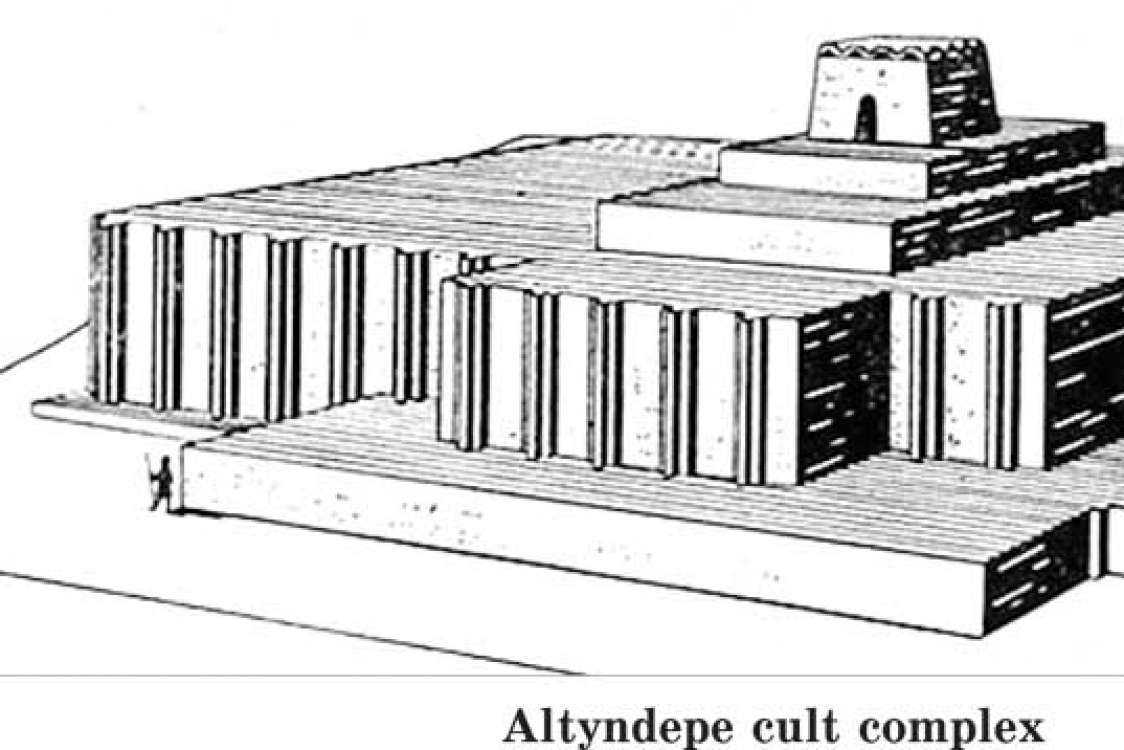
One of the unique sanctuaries is located on the model Bronze Age monument discovered by V.M. Masson – Altyn-Depe. In 1968, archaeological excavations allowed speaking with confidence about of a stepped tower-like building, which clearly followed the traditions of the famous Mesopotamian ziggurats. There was a rectangular altar in one of the rooms. The finds confirmed the cultic purpose of the entire burial ensemble.
Turkmenistan has a rich history of various cults and religious movements, as evidenced by archaeological discoveries. The Anau civilization, which refers to the ancient agricultural tribes of Tejen and Murghab living in the foothills of the Kopetdag Mountains during the Chalcolithic and Bronze Ages, left behind several religious buildings known as sanctuaries. Recent archaeological studies have shed new light on these monuments, some of which date back to the fourth millennium BC.
One such monument is the ancient Yassydepe settlement located 9.5 km north of Kaahka. Archaeologists discovered 18 quadrangular rooms with irregular shapes, some with hearths, and some decorated with colorful frescoes representing various geometric shapes. The sanctuary was adorned with a wooden colonnade and had several interconnected rooms with special places for sacrifice. The altar table was the focal point of the building, and the burning altar spotlighted its special purpose. Fellow tribesmen entered with reverence and fear to perform religious rituals and prayers.
Another example is the Karadepe sanctuary, located near the Artyk village in Kaahka etrap, which had two cube-shaped altars painted in several layers of black paint. Several cultic buildings were also found in the Geoksyur group of Eneolithic settlements, such as Dashlijadepe, Akchadepe, and Yalangachdepe.
Dashlijadepe is a small mound with a large rectangular room, a fireplace in the corner, and a sufa attached to the northern wall. Akchadepe is a square room with two pilaster projections inside, while Yalangachdepe has a large central room with tamga-like moulds on the wall with 15 recesses. The mould was believed to have a magical meaning, and the entire structure was most likely used for ritual purposes.
Overall, these sanctuaries and cultic buildings offer a glimpse into the religious practices of the Anau civilization and its distant predecessors of churches and cathedrals.
The Anau civilization's monuments are of great interest to scientists, and their thorough research is particularly relevant in the year of Anau's declaration as the Cultural Capital of the Turkic World. World-renowned scientist V.I. Sarianidi has concluded that such structures could be found in most temple buildings in Mesopotamia, where they used to signify the religious purpose of the buildings.
5585
5405
5325
4726
157
245

 338
338
 245
245
 310
310
 314
314
 371
371
 318
318
 485
485
 399
399